Chapter 6: The Kàrman shot sequence with the Infinity Bow™ — breathing cycles, macro-actions and exercises.
6.1The Kàrman Sequence: the Person Before the Movement
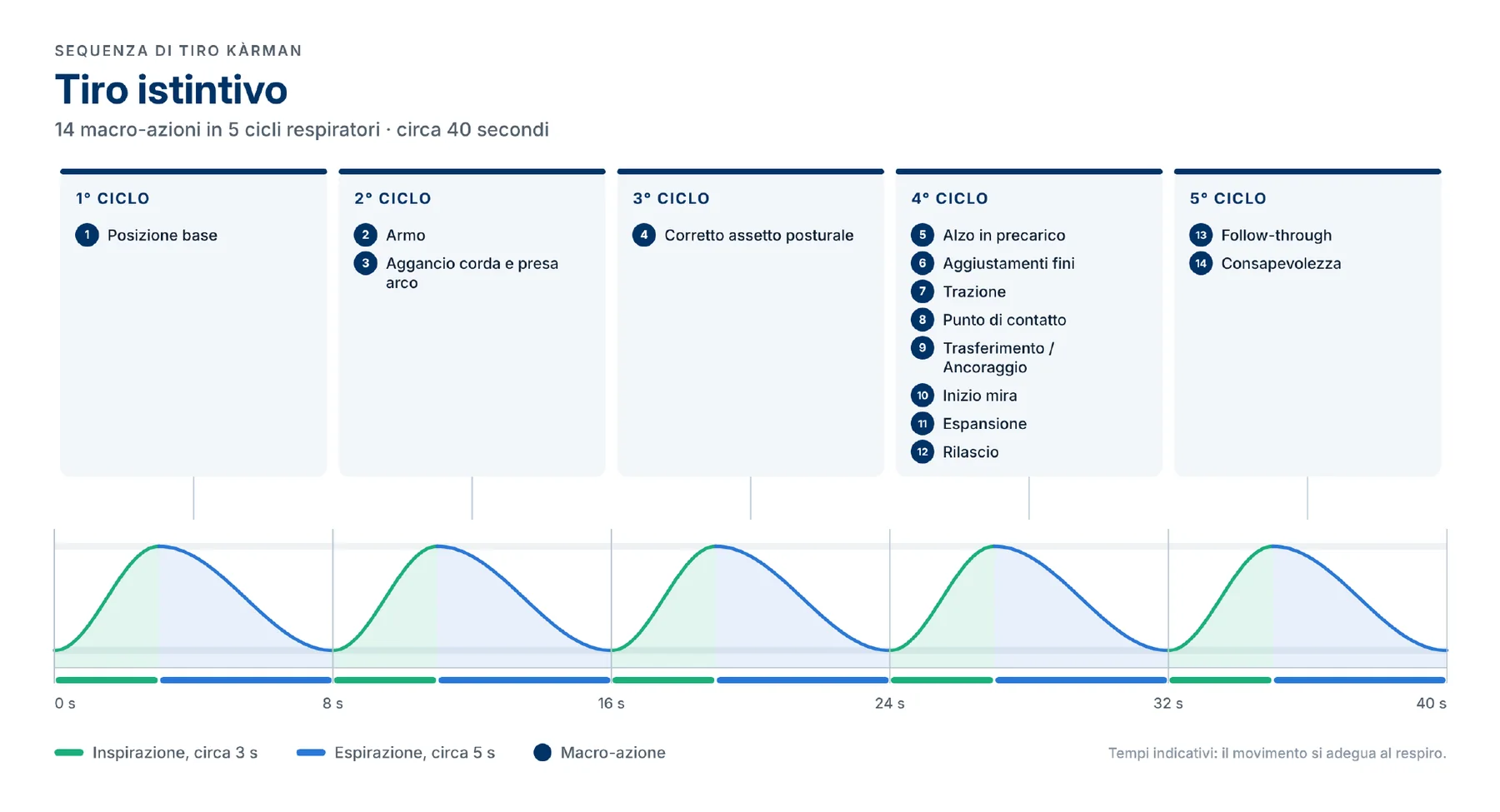
The Kàrman shot sequence, described in the book “Il Kàrma nel Tiro con l’Arco”, organises the shot into macro-actions paced by the breath. Each macro-action brings together several motor and mental actions, exteroceptive and proprioceptive, performed in succession or at the same time. Instinctive shooting unfolds in 14 macro-actions over 5 breathing cycles; sighted shooting in 16 macro-actions over 6 cycles. The first three cycles are common to both sequences.
This chapter goes through the sequence one macro-action at a time and shows how the Infinity Bow™ and its accessories make it possible to isolate it, repeat it and understand it. The tool does not replace the bow: it creates a protected environment, with no arrow, no target to hit and a moderate load, in which the learner can listen to their body before having to control it under pressure.
Four pedagogical principles
- Every archer is unique. The sequence is not a model to copy. As the book recalls, a shooting system is effective only if it can be shaped and adapted to the uniqueness of the person performing it: imitating a champion’s sequence, timing and equipment produces “a faded photocopy of the original”. The Instructor observes the person before the movement: age, physical build, sporting history, the emotions they bring to the range.
- In small steps. Before running, we learned to walk; before that, to crawl; and before that, to fall. Each macro-action is consolidated before adding the next. With the Infinity Bow™ you can stay on a single breathing cycle for as long as needed, without the rush to reach the release.
- Feel before correcting. After each repetition the Instructor asks the learner what they perceived before giving instructions. The accessories offer immediate feedback (a cross that moves, a cord that does not touch, a click that does not come), but their purpose is to educate internal perception, not to replace it. Like scaffolding on a building site (in pedagogy we speak of scaffolding), they are gradually removed once the sensation has become the archer’s own.
- Error is information. “The Kàrman learner respects errors”, the book says (see section 10.5). In dry practice an error does not cost an arrow off the target: it becomes study material, to be observed without judgement.
The Kàrman breathing cycle
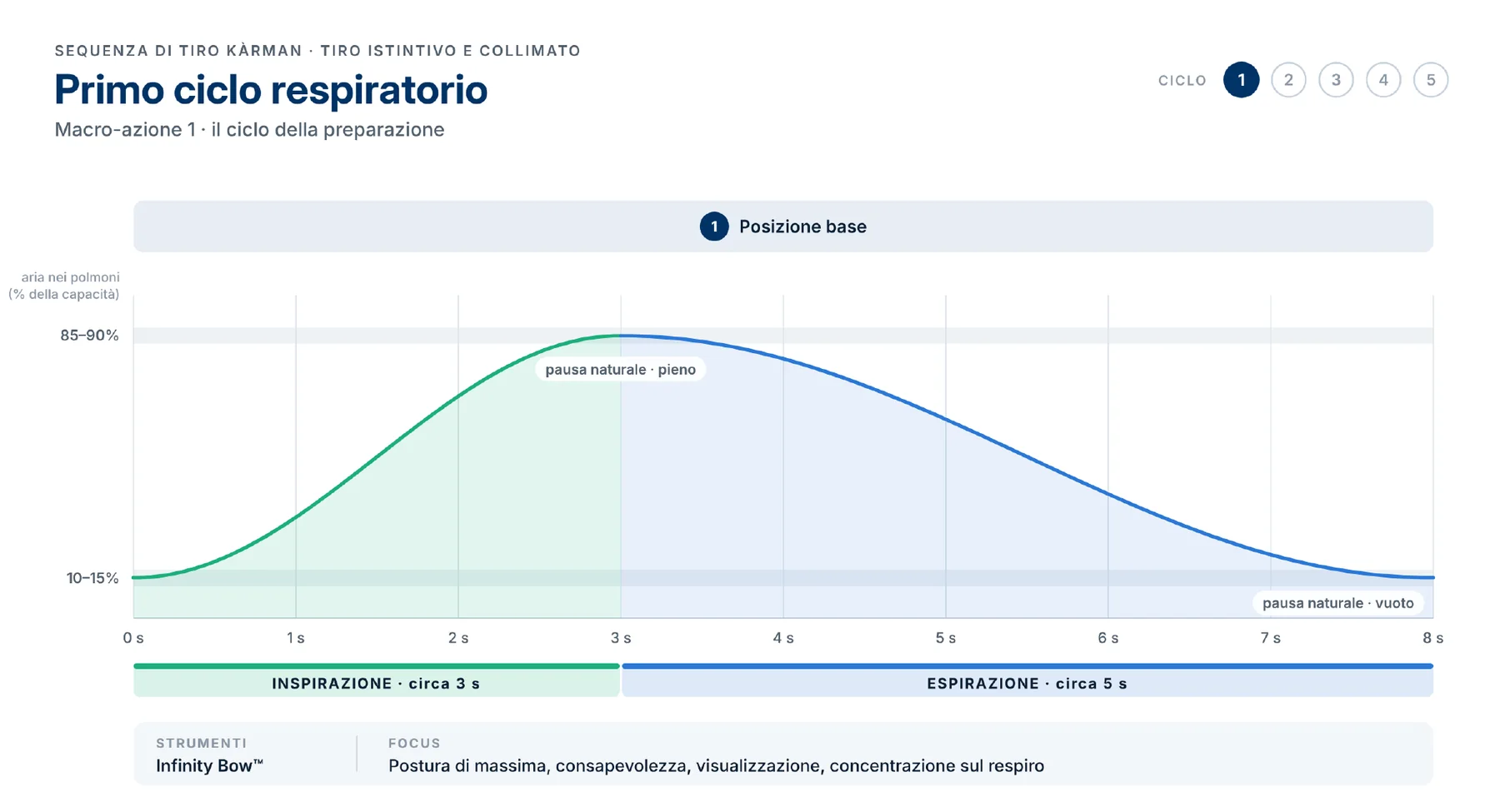
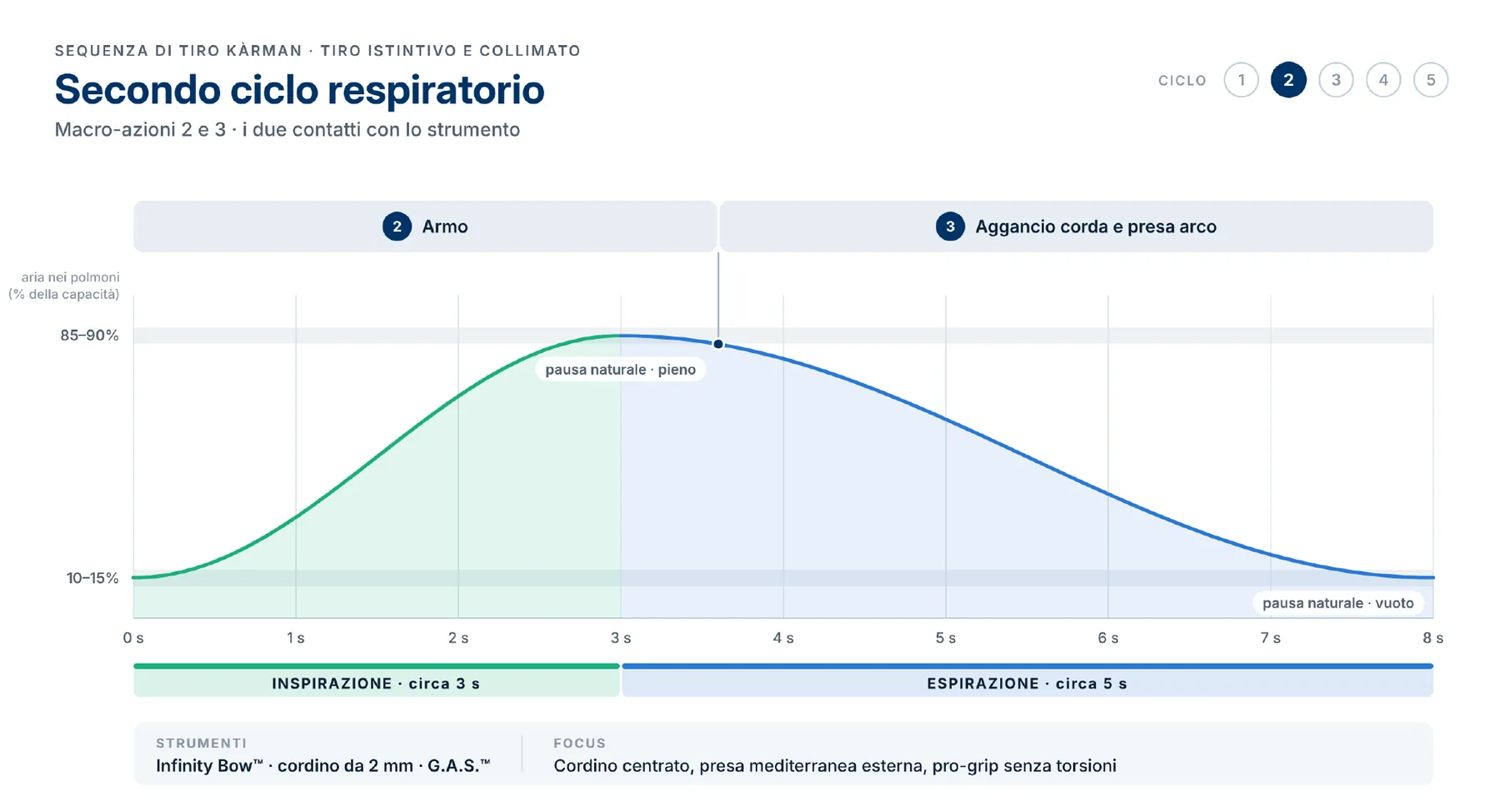
Each cycle lasts about 8 seconds: a diaphragmatic inhalation of about 3 seconds and an exhalation of about 5 seconds. On inhalation you reach about 85–90% of your capacity; on exhalation you do not go below 10–15%.
The Kàrman System does not use prolonged breath-holding, not even while aiming. The book explains why: holding the breath amplifies anxiety in moments of stress and breaks the fluidity of the movement. Instead, it uses the brief natural pauses between inhalation and exhalation (the “full”) and between exhalation and inhalation (the “empty”). Like an internal metronome, these pauses mark the passage from one action to the next and make the sequence more repeatable.
Fundamental rule: it is the movement that adapts to the length of the breath, not the other way round. The 3 and 5 seconds are a reference; someone with a shorter breath will perform the movements more quickly. With beginners you start from natural breathing and deepen it gradually.
How to read the sheets
For each breathing cycle the chapter describes the macro-actions according to the book, what changes when working with the Infinity Bow™, the useful accessories, the exercises, the most frequent errors and the transfer to the bow. Exercises carry the number of the macro-action they refer to: Exercise 3.2, for example, belongs to macro-action 3. Volumes and rests are indicative: the Instructor adapts them to the learner’s age, physical condition and response. Each cycle is introduced by a full-page plate summarising its timing: the plates are a graphic reworking of the charts in the book.
Before every session check the integrity of the junctions between elastic and cord (chapter 3).
6.2First Breathing Cycle — 1) Stance
With the stance, an act of will begins: it is the point where everything is born. The book describes it as the most personal of the macro-actions, because it evolves over time and matures with practice. The main work is internal: the archer prepares, gathers their attention and opens the way to mastery of breath and mind. The whole first breathing cycle is devoted to this preparation.
The four elements of the stance
- General posture. The book proposes three stances relative to the target. The parallel stance is the reference for beginners: simple, balanced, repeatable in almost all conditions. The open stance suits target archery: it gives greater stability to the trunk and legs and better work of the back muscles. The mobility stance is aimed at shooting on the move and hunting, and is the hardest to perform. In the parallel stance the archer stands side-on to the target; the feet, parallel and at shoulder width, rest on the imaginary line joining them to the target. It is a general, gross-motor adjustment.
- Awareness. The ability to notice what you perceive and your own responses. The archer integrates information from outside (light, wind, noise) with what comes from their own body and emotions.
- Visualisation (mastery of the mind). The archer mentally and quickly runs through the whole shot sequence.
- Concentration (mastery of the breath). Attention gathers on the breath, which from this moment becomes the metronome of the whole ritual. The book sums it up like this: “First gather, then turn all your will towards centring, not the centre.”
Biomechanical notes
Body weight is spread evenly over both feet and, on each foot, over three support points: the base of the big toe, the base of the little toe and the heel. The knees keep a slight natural bend, that is, unlocked and slightly flexed. Breathing is diaphragmatic: on inhalation the abdomen expands and the shoulders do not rise.
With the Infinity Bow™
The Infinity Bow™ is held gently and rests against the leg facing the target, as the book indicates for the bow. No accessory is needed. For beginners the absence of arrow and target is especially valuable: the stance can be experienced as a space of calm, without the urge to “shoot”.
Exercises
Exercise 1.1 — Foot rooting. Barefoot or in flat shoes, the archer sways slightly forwards and backwards and from side to side, reducing the sway until they feel the weight spread over the three support points of both feet.
Exercise 1.2 — The three stances. With the Infinity Bow™ in hand, the archer takes the parallel stance, then the open stance, then the mobility stance, staying in each for three breathing cycles, and describes to the Instructor the differences they perceive (stability, trunk rotation, view of the target). With beginners, work on the parallel stance only.
Exercise 1.3 — The breathing metronome. With a watch that counts the seconds, the archer breathes diaphragmatically following the pattern of 3" inhalation and 5" exhalation for 3–5 minutes, as the book suggests.
Exercise 1.4 — Visualising the sequence. During one breathing cycle, eyes closed, the archer mentally goes through all the macro-actions, up to the final awareness.
| Exercise | Accessory | Breathing and focus | Indicative volume | Rest between sets |
|---|---|---|---|---|
| Ex. 1.1 Foot rooting | — | Natural breathing; weight on the three support points | 3 sets of 1 minute | 30 seconds |
| Ex. 1.2 The three stances | Infinity Bow™ | 3 cycles per stance; listening to the differences | 2 sets | 45 seconds |
| Ex. 1.3 Breathing metronome | — | 3" IN / 5" OUT; shoulders still, abdomen expanding | 3–5 minutes continuously | — |
| Ex. 1.4 Visualisation | — | Eyes closed; one or more cycles | 5 repetitions | 30 seconds |
Frequent errors and how to support their correction
- Weight on the heels or the toes: go back to Exercise 1.1 before continuing.
- High, chest breathing, with the shoulders rising on inhalation: place a hand on the abdomen and work on Exercise 1.3.
- Hurrying on to the next cycle: the book is explicit — beginners must practise the first cycle several times before moving on to the second. It is not time wasted: it is the foundation of everything that follows.
Bridge to the bow
The stance transfers unchanged to the school bow: same general posture, same breathing, same visualisation. Only the weight of the equipment in the hand changes.
6.3Second Breathing Cycle — 2) Nocking and 3) String Hook and Bow Grip
With the second cycle the gestural “empty” of the first is broken and the “full” opens: the alternation between breath and action that will accompany the whole ritual begins. In this cycle the archer creates the only two points of physical contact with the tool: the string and the grip. All the following phases depend on the quality of these two contacts.
2) Nocking
At the start of the inhalation the archer performs an act of will: nocking the arrow. Without losing the goal identified in the first cycle, they shift their focus to the equipment, with the bow held in front of the torso. The book recalls that “kàrma”, in Western languages, means “action”: it is the archer, with their intention, who completes the connection between bow and arrow.
With the Infinity Bow™. The tool uses no arrows: nocking becomes a mindful check of the equipment. The archer deliberately takes the hand off the 2 mm cord and checks that the elastic is centred on the Infinity Bow™, with the same attention and the same act of will with which they would nock an arrow. It must not become a distracted automatism: it is a moment of the ritual, which trains the archer and prepares them for the next step, hooking the string.
3) String hook
The book identifies three reasons for caring about the position of the string hand.
- Control: an inconsistent hook cascades into all the following phases and alters the geometry of the bow.
- Release: the distribution of the load on the fingers determines the quality of the release.
- Safety: an incorrect hook concentrates the load on a few points and, at high draw weights, can cause calluses, pain and paraesthesia.
The Kàrman Sequence uses a shallower Mediterranean hook, built in four steps:
- The string is placed in the middle of the crease between the second and third phalanx of the middle finger, 2–3 mm below the nocking point. A very slight pre-draw lets it slide onto the third phalanx, no more than 2 mm from the joint.
- The other fingers extend and relax: for a moment the middle finger carries the whole load.
- The index finger is added, 2–3 mm above the nocking point, with the string on the joint between the second and third phalanx: the load is shared between index and middle.
- The ring finger, the “control finger”, is added, leaving a slight space below the middle finger: with light pressure it keeps the load balanced between index and middle throughout the draw.
Finally the whole forearm rotates by about 45°: the thumb moves from pointing upwards to a position close to the archer, and palm and forearm turn towards the ground. The fingers contract only as much as needed to hold the string.
With the Infinity Bow™. The 2 mm cord reproduces the feel of the string on the finger joints; its centre point, between the two elastics, serves as the reference in place of the nocking point. The book recommends developing this sensation with bows of very low draw weight and without glove or tab, then reproducing it faithfully with the protection on: this is exactly the condition the Infinity Bow™ offers.
3) Bow grip in pro-grip
The grip rests gently in the hand. The pivot point acts as a fulcrum between the upper and lower halves of the bow and is the only point of balance between the forward push of the riser and the opposing push of the limbs. Every involuntary twist of the hand is transmitted to the bow and therefore to the arrow. The book describes the correct grip as an “active passivity”: the hand supports the bow’s natural movement without opposing it. To get there it proposes a perceptual sequence:
- Side-on to the target, arms by the sides and shoulders low, the archer brings attention to the fleshy pad between thumb and index finger of the bow hand (the thumb abductor muscle) for a few breathing cycles.
- Turning the head towards the bow arm, they slowly raise the arm to shoulder height, with the hand relaxed and the palm facing the ground.
- They raise the palm until it is aligned with the forearm: the four fingers are in line with the arm, the thumb about 30° off axis.
- Keeping the palm down, they rotate the hand until the thumb is aligned: the little-finger knuckle moves back.
- Without moving arm and forearm, they rotate the wrist, pushing the pad between thumb and index finger towards the extension of the arm.
The result is a hand tilted at about 45°, with relaxed fingers and the thumb relaxed and pointing towards the target. The Instructor can offer the bow in pro-grip to the learner and guide them in perceiving the contact points between palm and grip.
With the Infinity Bow™ and the G.A.S.™. The Modular Grip reproduces the pivot point and pressure points of the handle. With the G.A.S.™ fitted, the micro-tensions of the hand become visible: at a pre-tension of 1–2 cm the cross must stay centred and the bubble in the middle. If the cross moves up or down, the pressure has slipped towards the web between thumb and index finger or towards the heel of the palm; if it moves sideways, the wrist is rotating.
Exercises
Exercise 2.1 — Mindful nocking. At the start of the inhalation the archer takes the hand off the cord and checks that the elastic is centred on the Infinity Bow™. During the exhalation they keep their gaze on a target or a distant point. This sequence must happen without hurrying.
Exercise 3.1 — Building the hook in one breathing cycle. The whole hook is formed in a single cycle, with attention on the succession of steps. On the inhalation (about 3 seconds) the middle finger takes the string and the other fingers extend; at full, the middle finger alone carries the load. On the exhalation (about 5 seconds) the index and ring fingers are added, then the forearm rotates by about 45°. At empty, the hook is complete. The first sets are done watching the hand, then with eyes closed.
Exercise 3.2 — Releasing finger tension. With the hook formed and a pre-draw of 2–3 cm, during the exhalation the archer lets go of any unnecessary tension in the forearm: the fingers remain passive hooks, the wrist is aligned.
Exercise 3.3 — Guided pro-grip. The book’s five-step sequence, first without the tool, then with the Instructor placing the Infinity Bow™ in the learner’s hand.
Exercise 3.4 — Centred cross with the G.A.S.™. At a pre-tension of 1–2 cm, the archer keeps the cross centred and the bubble in the middle for a whole breathing cycle. Then the Instructor asks them to deliberately shift the pressure up and down and to rotate the wrist, so that the learner recognises what they see and what they feel in each case.
Exercise 3.5 — Vertical axis of the frame. Without the G.A.S.™, the archer performs 5 pre-tensions of 2–3 cm while watching the frame: if the hand introduces torque, the ring tilts sideways. Over time control moves from the eye to the sensation: the same exercise is repeated with eyes closed, with the Instructor watching.
| Exercise | Accessory | Breathing and focus | Indicative volume | Rest between sets |
|---|---|---|---|---|
| Ex. 2.1 Mindful nocking | Infinity Bow™ (elastic centred) | Inhalation; hand off, gaze on the elastic | 3 sets of 5 cycles | 30 seconds |
| Ex. 3.1 Hook in one cycle | 2 mm cord | One cycle: middle finger and fingers on inhalation; index, ring and rotation on exhalation | 3 sets of 5 repetitions | 45 seconds |
| Ex. 3.2 Releasing finger tension | 2 mm cord | Exhalation; soft forearm, aligned wrist | 3 sets of 5 cycles | 45 seconds |
| Ex. 3.3 Guided pro-grip | Infinity Bow™ | Five steps; one step per cycle | 3 complete repetitions | 45 seconds |
| Ex. 3.4 Centred cross | G.A.S.™ | A whole cycle with cross and bubble centred | 3 sets of 5 cycles | 45 seconds |
| Ex. 3.5 Vertical axis of the frame | Infinity Bow™ | 5 pre-tensions; then with eyes closed | 2 sets per variant | 45 seconds |
Frequent errors and how to support their correction
- “Clawed” fingers and tense forearm: reduce the pre-draw and go back to Exercise 3.2.
- String too deep on the fingers (deep hook): rebuild the hook with Exercise 3.1.
- Hand squeezing the grip or thumb pushing: the G.A.S.™ cross moves; go back to Exercise 3.3.
- Ring tilting sideways at pre-tension: torque of the hand on the grip; Exercise 3.5.
Bridge to the bow
Hook and pro-grip are transferred to the school bow first without an arrow and at low draw weight, then with finger protection on, checking that the sensation built with the Infinity Bow™ stays the same.