2.1The Infinity Bow™ Training Simulator
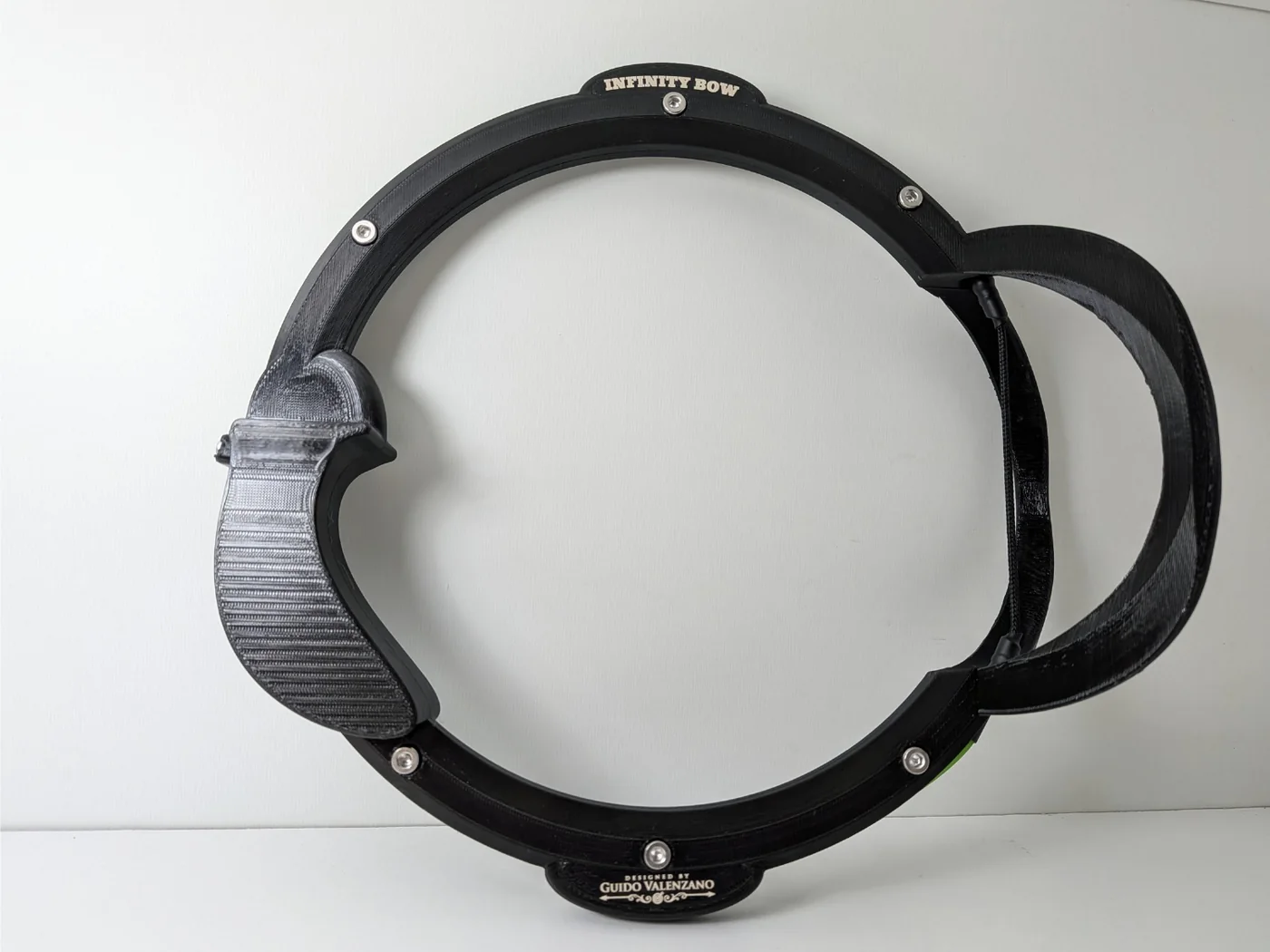
The Infinity Bow™ is an advanced training simulator designed for the dynamic and postural simulation of archery, engineered with new technologies applied to archery (high-density 3D printing). Made from technical polymers with high mechanical stability (ABS and PETG-CF), it combines ergonomics, rigidity and lightness to deliver a teaching experience of the highest precision.
Unlike traditional equipment, the Infinity Bow™ balances the load to optimise learning:
- Weighted and Balanced Mass (310 g): It gives the physical feel of the bow’s mass without tiring the bow arm, making it possible to hold ideal alignment and avoiding shoulder collapse or incorrect postural compensations.
- Calibrated Dynamic Resistance (about 10–12 lbs at 28" with the standard 2050 model): The load of the natural-latex tubular elastomers (standard model 2050 and light model 1745) is specifically designed to activate proprioception of the movement: it provides the draw force needed to stimulate motor memory and the work of the back muscles (back tension), preventing parasitic tension.
- Removal of Performance Anxiety: It removes the visual conditioning of the target, allowing the archer to focus the mind 100% on body awareness, on the development of the sensory analysers and on the fluidity of the movement.
2.2Experience Kit & 3D-Printed Support Accessories
The Infinity Bow™ is supplied in two configurations designed for different needs:
- Essential Kit: The complete Infinity Bow™, ready for immediate use in the field.
- Experience Kit: The complete solution for instructor and athlete. It includes the Infinity Bow™ simulator, the 3D Desk Stand for upright storage on a desk or workbench, the 3D Multi-purpose Hook for attaching it to a quiver or belt and for fixed wall mounting, and a Spare Dynamic String (elastomer + serving).
2.3Analysis and Official Nomenclature of the Components
The Infinity Bow™ has an advanced circular geometry (outer diameter 255 mm, thickness 28 mm, weight 310 g) and is engineered in six main functional modules:
- Symmetrical Modules: Outer ring structure made of two mirror-image half-shells in high-density polymer (ABS / PETG-CF) joined by 6 steel M4×12 hex-head screws, designed to ensure torsional stability and absorb dynamic stresses.
- Ergonomic Grip: A shaped handle with a clearly defined Pivot Point and load areas for the high/low, inner and outer pressure points. It teaches the archer to release force with the hand tilted at 45° and the thumb relaxed and pointing towards the target, preventing parasitic grip torque.
- Tip-Lock Seat: Upper interlocking module that acts as the mechanical end stop for the string and provides the rigid mount for the Bow-Clip of the AeroAxis™ and the other Kàrman accessories.
- Closed-Loop Dynamic String: A combination of natural-latex tubular elastomer (standard model 2050, about 10–12 lbs at 28"; light model 1745, lower load) and high-strength 2 mm braided Paracord. It reproduces the feel of a real string on the finger joints and eliminates the braking effect of friction.
- Inner Side Projections (Deflectors & Proprioceptive Feedback): Two prominences inside the circular profile that guide the elastic back after release (preventing it from striking the forearm) and provide immediate tactile feedback: they lightly brush the forearm when shoulders and elbow are perfectly aligned.
- String-Guide Slots: Internal perimeter channels that keep the elastic in place while allowing it to rotate freely by inertia after release (Clean Release).
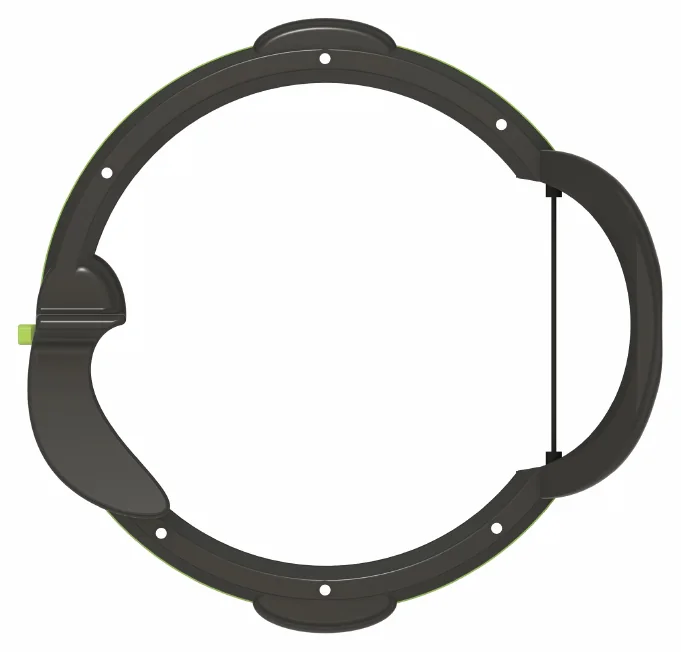
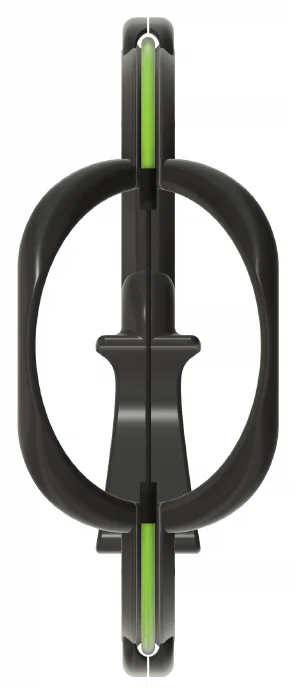
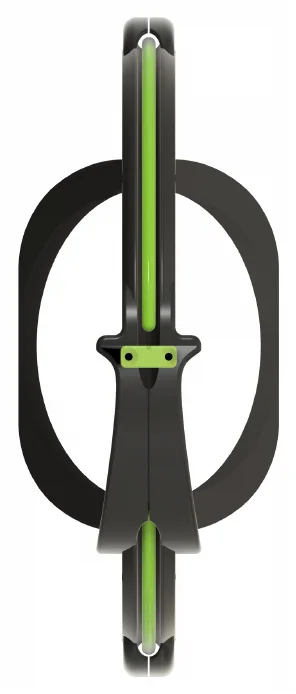
Views of the 3D model with the dynamic string fitted (5 mm green latex tube and 2 mm cord) are shown in Plates 2.2 and 2.3.
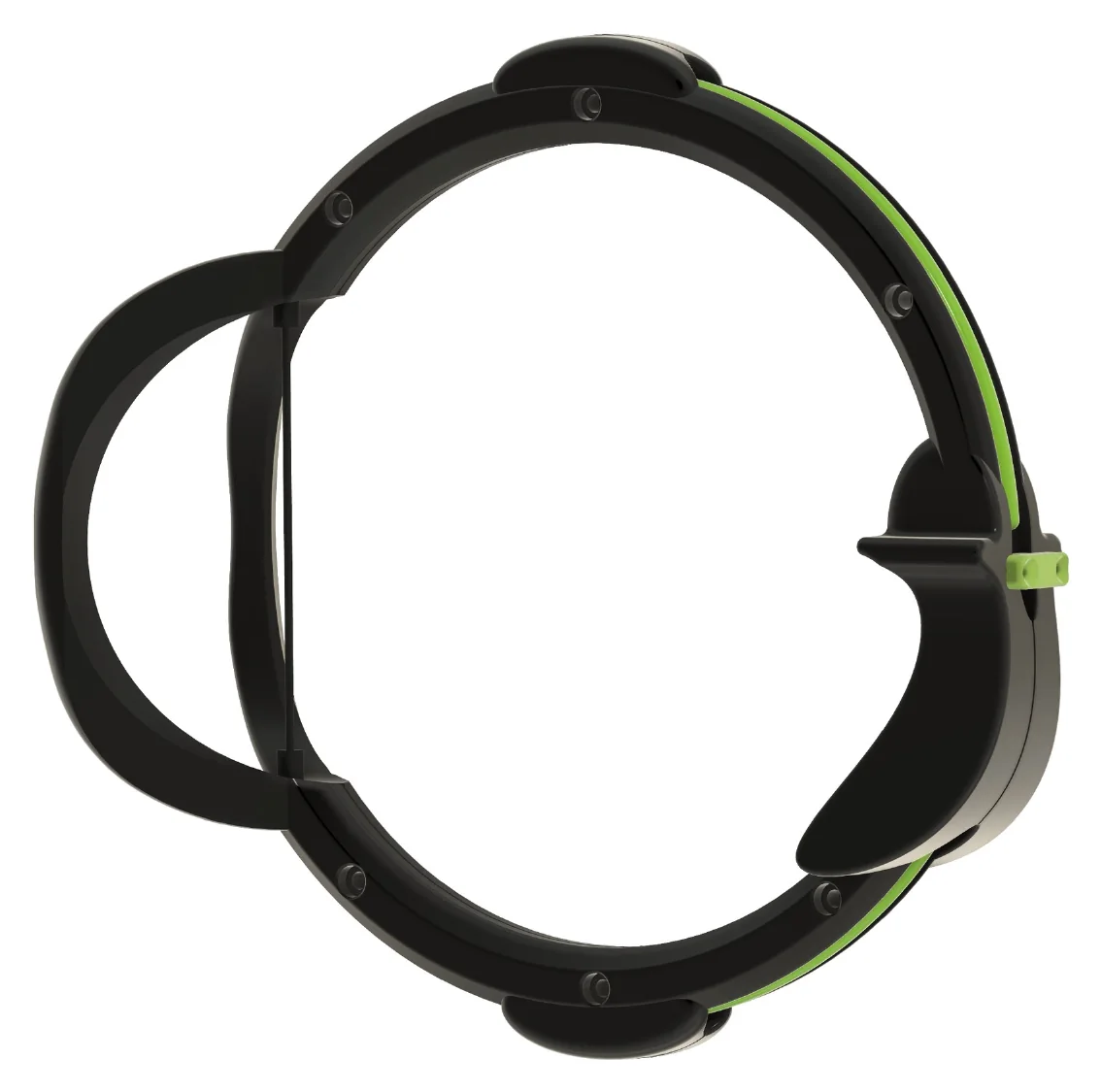
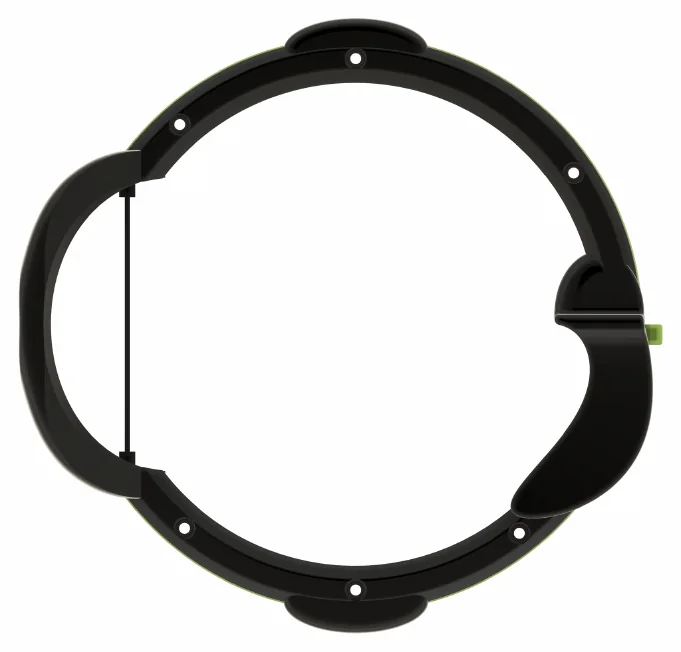 a) Front view
 b) Rear view
 c) Side view, cord side
 d) Side view, grip side
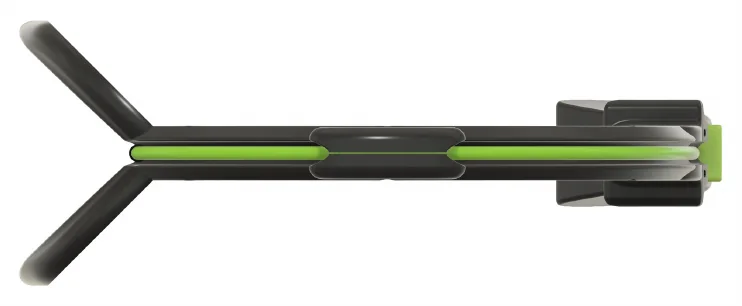 e) Top view
| View | Description |
|---|---|
| 2.3a · Front | Grip with the green block on the right, vertical cord on the left with sleeves at the ends; the six M4×12 screws are visible. |
| 2.3b · Back | The opposite side of the ring, as it appears in the product photos: grip on the left, cord on the right. |
| 2.3c · Cord side | Edge-on: the 2 mm cord in the centre; above and below, the green tube in the groove; the sleeves cover the joints. |
| 2.3d · Grip side | Edge-on: the green block and the tube entering the frame where the grip begins. |
| 2.3e · Top | The two halves of the ring, the green tube in the central groove and, on the right, the grip. |
2.4Anatomical and Structural Analysis of the Infinity Bow™
The closed-ring circular architecture is the core principle of the Infinity Bow™ design. This shape distributes mechanical stresses evenly around the circumference, eliminating the bending peaks typical of traditional rigid limbs.
2.5Release Dynamics and Manual Repositioning of the String
To ensure the latex elastic closes correctly after release, the string of the Infinity Bow™ is designed to remain partly free to rotate along its circular axis.
Although the Tip-Lock Seat acts as a stop during the draw, immediately after release the string makes a slight rotation by inertia. This freedom of movement is essential to dissipate the residual energy and simulate the fluidity of a real release.
After the shot: Once the release is complete, the archer or instructor, if needed, guides the string back to its starting position with light manual pressure, realigning the Serving Simulator with the Tip-Lock Seat for the next shot.
2.6Technical Specifications and Materials
| Technical parameter | Value / specification |
|---|---|
| Frame geometry | Closed-ring circular structure (diameter 255 mm, thickness 28 mm) |
| Construction materials | High-density ABS / PETG-CF polymers (FDM 3D printing) |
| Total mass | 310 g (± 5 g due to infill density tolerance) |
| Dynamic string, standard model "2050" | Latex tube, 2 mm inner diameter and 5 mm outer; about 10–12 lbs at 28" draw length |
| Dynamic string, light model "1745" | Latex tube, 1.7 mm inner diameter and 4.5 mm outer; lower load |
| Serving simulator | High-strength braided cord (2.0 mm diameter) |
| Fasteners | 6 steel M4×12 mm hex-head screws |
| Adjustments | None: the load is changed by replacing the dynamic string |
| Use | Dry use only, ambidextrous; the tool is not designed to shoot arrows |