6.6Fifth Breathing Cycle (Instinctive Shooting) — 13) Follow-through and 14) Awareness
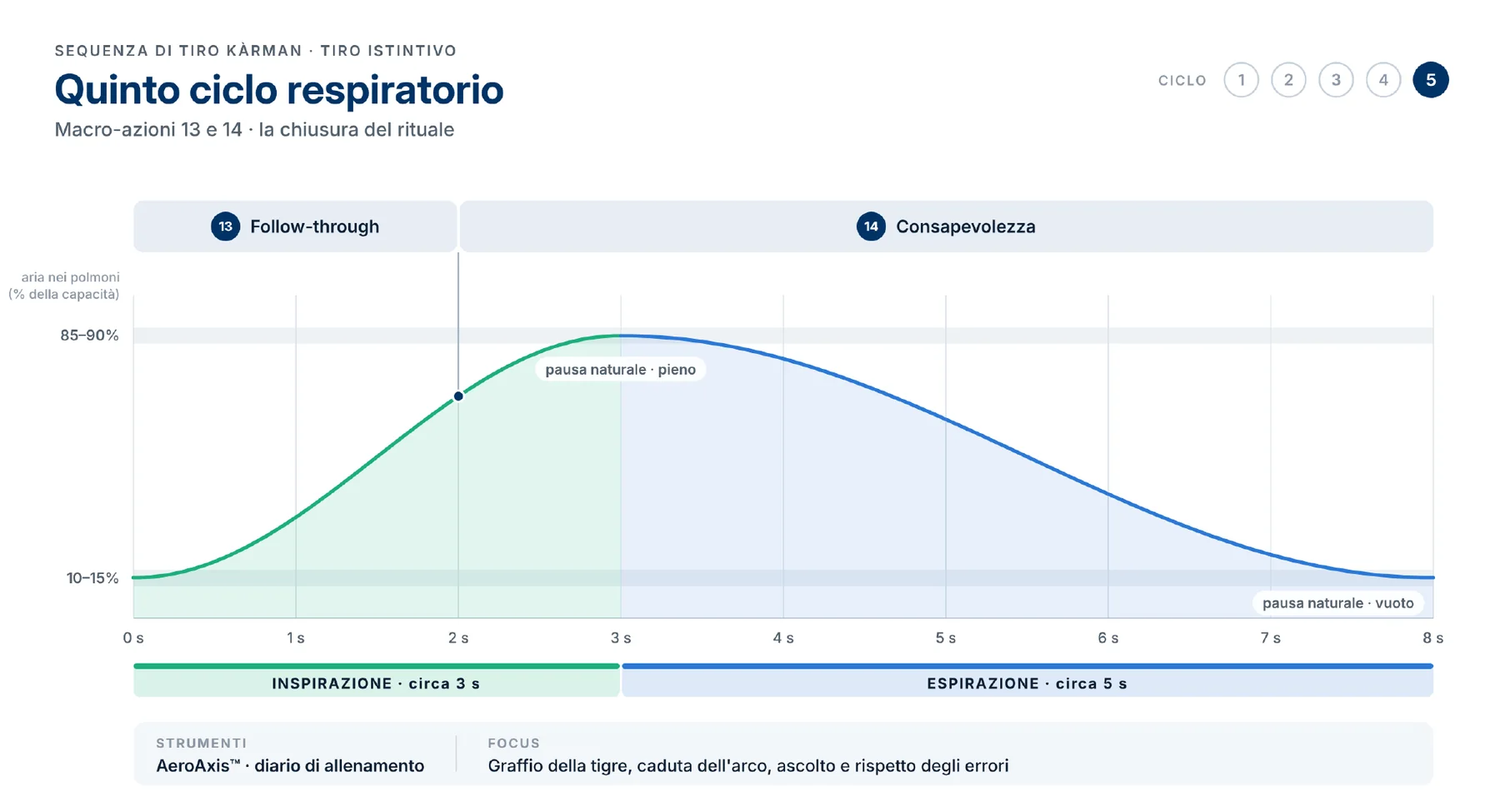
In instinctive shooting the fifth cycle is the last. The book calls it delicate, often neglected but of the highest importance, especially for new learners. After the release there is a significant discharge of forces and the archer “expands their being”: physically, freeing themselves from the load of the bow, and through visualisation, following the arrow’s trajectory.
13) Follow-through
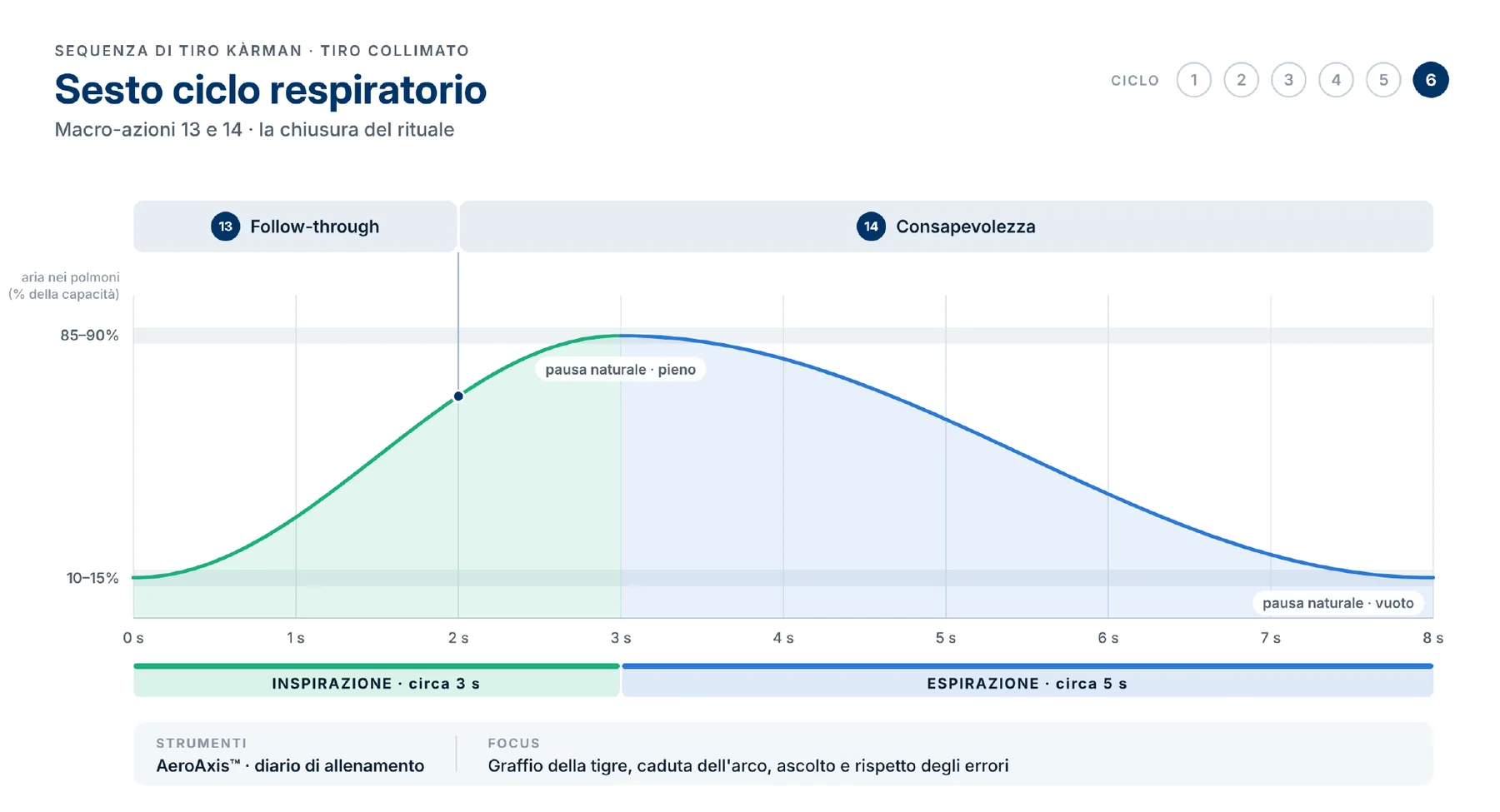
At the start of the inhalation (in the book’s charts, roughly the first 2 seconds) the two actions of the follow-through take place:
- String side, the tiger’s scratch. Thanks to the correct push/pull balance, immediately after the release the fingers of the string hand slide from the face to the neck, almost to the shoulder, with a clear backward movement of the string arm away from the target. It is one of the main indicators of a correct, repeatable shot.
- Bow side, the bow drop. After the release the forces on the bow arm and bow hand reverse. The push on the grip turns into a natural downward rotation of the wrist, which accompanies the bow without interfering with its movement. When shooting traditional bows this rotation is less pronounced than it often is with the Olympic recurve: the Pro-Grip lets the hand stay relaxed, projects the push towards the target and brings the wrist into a slight forward flexion.
With the Infinity Bow™ and the AeroAxis™. After the tiger’s scratch the AeroAxis™ cord must always touch the same point (base of the neck or upper chest) throughout the inhalation. For the bow drop, the wrist rotates downwards and accompanies the frame forward, while the relaxed fingers hold it without squeezing.
14) Awareness
The rest of the cycle, and in particular the last seconds of the exhalation, is devoted to awareness. It is often described only as self-analysis, the moment when the archer evaluates the result and the execution. In the Kàrman System it is something deeper: with the last exhalation the ritual closes, in a phase that does not change with the tool or the technique. At first it appears as a whirl of information; the Kàrman learner learns to respect errors instead of blaming them on the bow, the arrow or the target.
With the Infinity Bow™, awareness has a pedagogical advantage: there is no score to distract attention, and what is observed is the quality of the perceived sequence. The Instructor asks open questions (“What did you feel in the scapula?”, “Did your breathing stay fluid?”) and lets the learner find the words. A short training diary can be useful, in which to note after each session one positive sensation and one point to work on.
Exercises
Exercise 13.1 — Tiger’s scratch with the AeroAxis™. After the release the archer holds the follow-through for the whole inhalation and checks that the cord always touches the same point.
Exercise 13.2 — Bow drop. The archer lets the wrist rotate downwards after the release, without squeezing the grip; the Instructor checks that the movement is soft and repeatable.
Exercise 14.1 — Listening on the exhalation. During the 5" exhalation the archer stays still and listens; at the end they say a single word describing the main sensation.
Exercise 14.2 — Training diary. At the end of the session the archer notes one positive sensation, one point to work on and one goal for the next session.
| Exercise | Accessory | Breathing and focus | Indicative volume | Rest between sets |
|---|---|---|---|---|
| Ex. 13.1 Tiger’s scratch | AeroAxis™ | Full inhalation; contact always at the same point | 3 sets of 5 cycles | 45 seconds |
| Ex. 13.2 Bow drop | Infinity Bow™ | Inhalation; soft wrist, relaxed fingers | 3 sets of 5 cycles | 45 seconds |
| Ex. 14.1 Listening on the exhalation | — | 5" OUT; one word at the end | At every sequence | — |
| Ex. 14.2 Training diary | Notebook | One sensation, one point to work on, one goal | At the end of the session | — |
Frequent errors and how to support their correction
- String hand stopping or opening forward after the release: insufficient push/pull balance; go back to Exercise 9.1.
- Bow lowered immediately to look: the follow-through is interrupted; keep the full inhalation (Exercise 13.1).
- Awareness reduced to a judgement (“bad shot”): the Instructor brings attention back to the sensations, with open questions.
6.7Sighted Shooting: Fourth, Fifth and Sixth Cycle (Macro-actions 15 and 16)
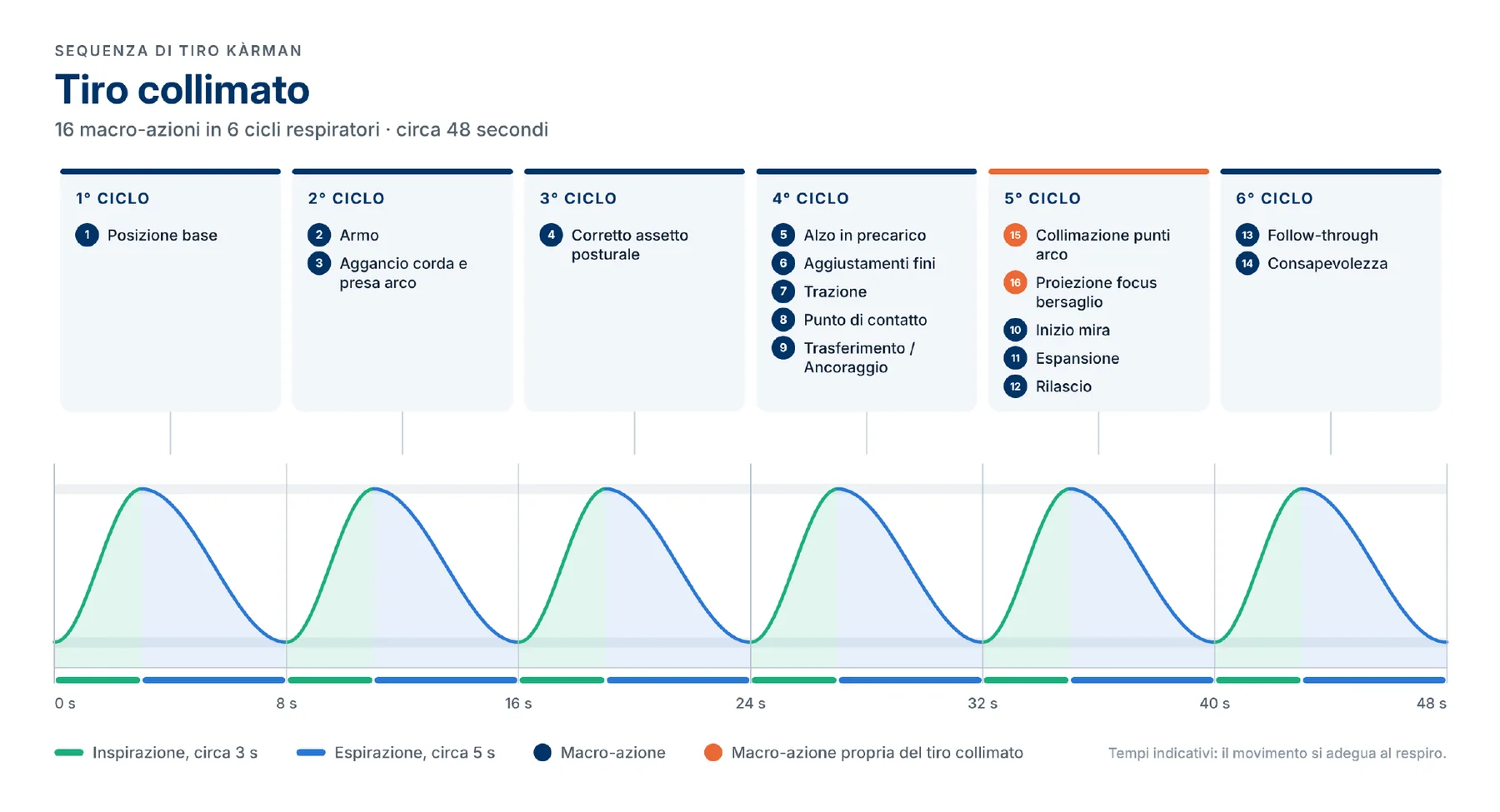
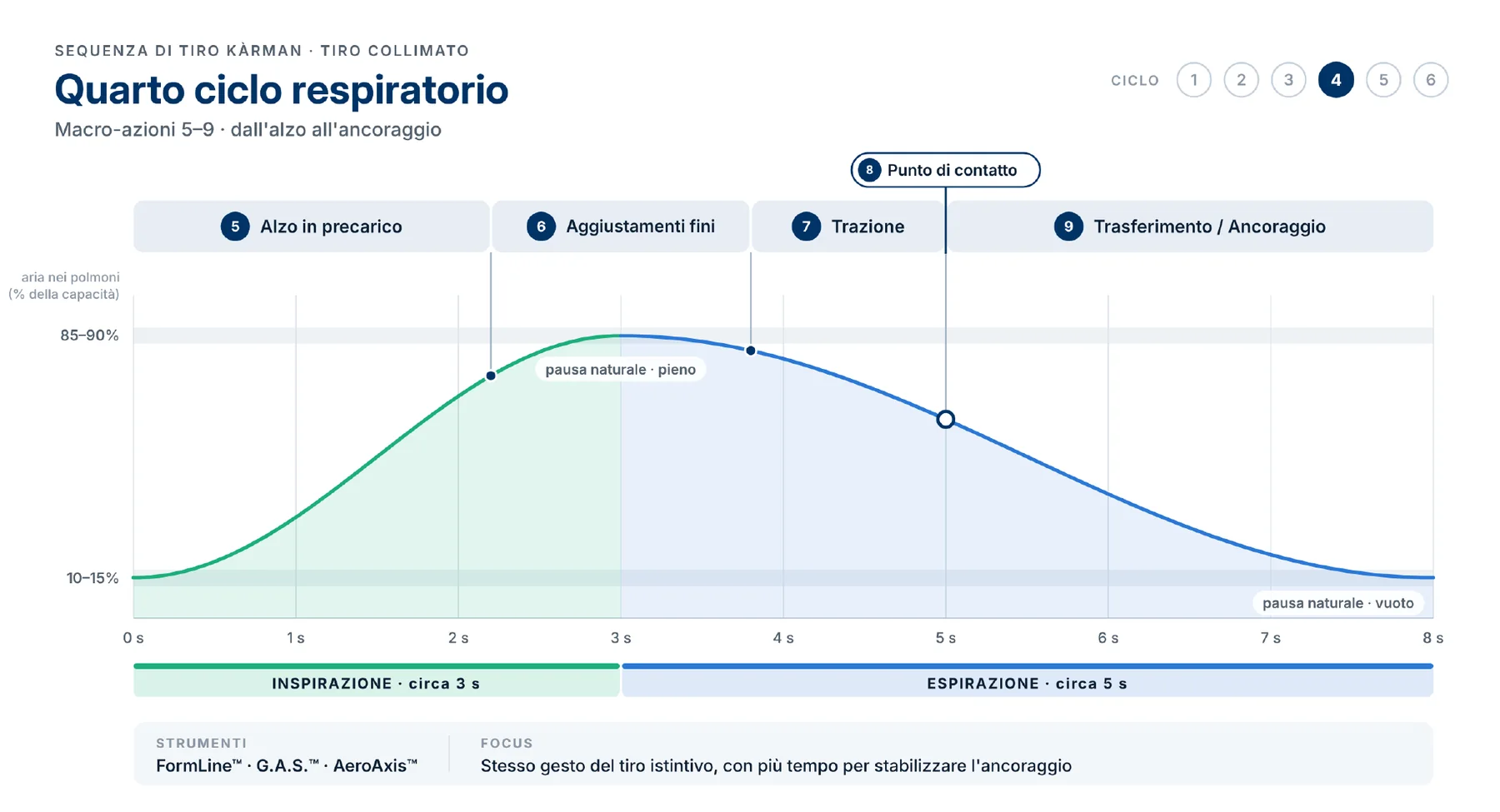
The book stresses that in the Kàrman philosophy there is no “way of the arrow” nobler than another: the choice of how to be moved by the bow belongs to the archer. The sighted-shooting sequence has one more breathing cycle and two more macro-actions. The first three cycles are identical to those of instinctive shooting; the fourth changes its timing and ends with the transfer/anchor; it is in the fifth cycle that the real difference between the two choices of shooting takes shape.
| Cycle | Time (approx.) | Breath | Macro-action (sighted shooting) |
|---|---|---|---|
| 4th | 0–2.2" | Inhalation | 5) Pre-loaded raise |
| 4th | 2.2–3.8" | End of inhalation and natural pause at full | 6) Fine adjustments |
| 4th | 3.8–5" | Exhalation | 7) Draw |
| 4th | 5" | Exhalation | 8) Contact point |
| 4th | 5–8" | Exhalation | 9) Transfer / Anchor point |
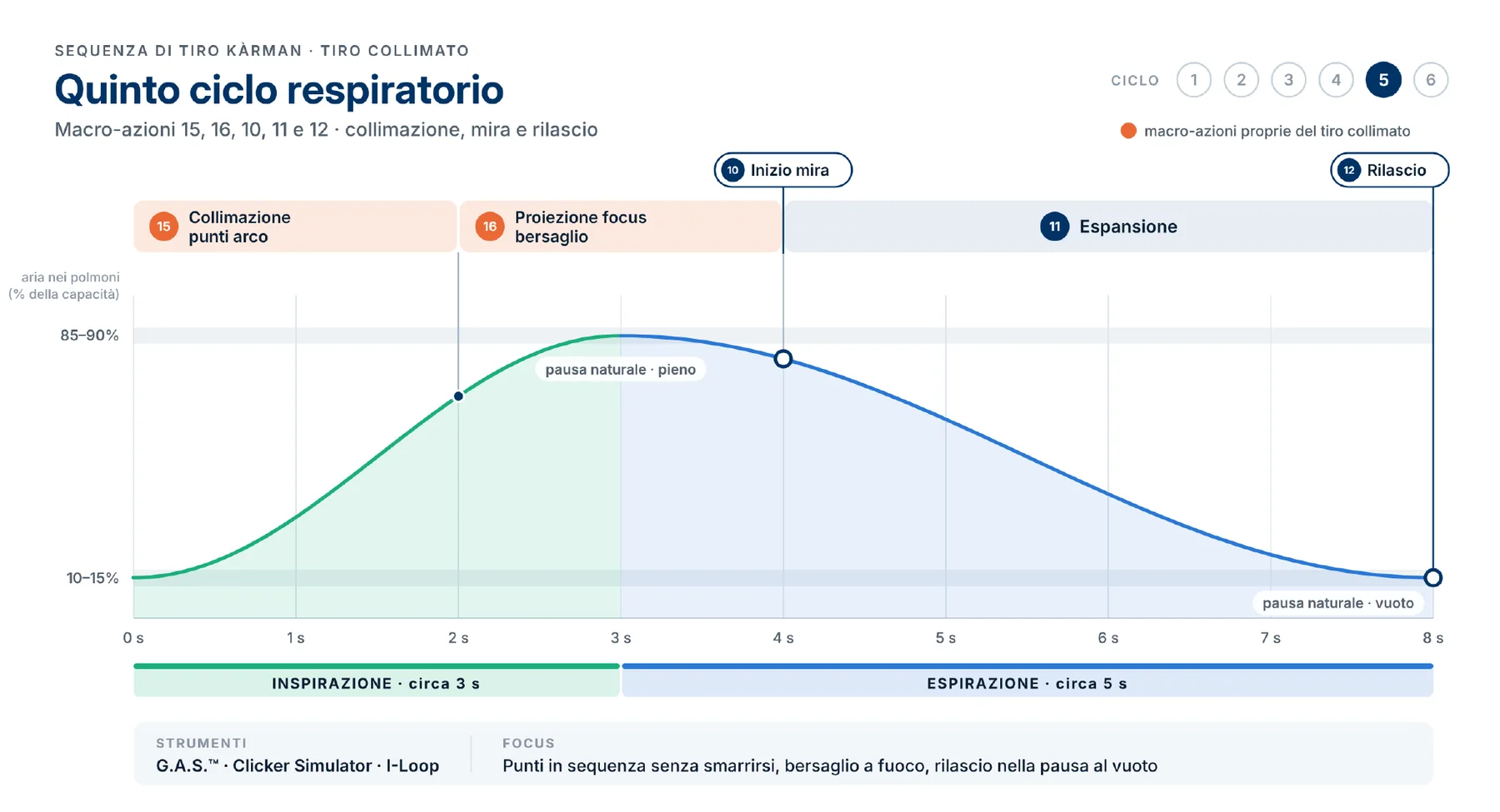
| 5th | 0–2" | Inhalation | 15) Sight alignment |
| 5th | 2–4" | End of inhalation, pause at full and start of exhalation | 16) Projection of focus onto the target |
| 5th | 4" | Exhalation | 10) Start of aiming |
| 5th | 4–8" | Exhalation | 11) Expansion |
| 5th | 8" | Natural pause at empty | 12) Release |
| 6th | 0–2" | Inhalation | 13) Follow-through |
| 6th | 2–8" | End of inhalation and exhalation | 14) Awareness |
15) Sight alignment
In the fifth cycle the archer briefly shifts their focus to the equipment, without “getting lost” in technique: they visualise in sequence the points to align and move quickly on to the next macro-action. The points change with the bow (barebow, Olympic recurve or compound). The book uses the example of barebow with the string-walking technique, the first alignment system taught in the Kàrman Sequence:
- elbow in line with the kneecap; if not, raise or lower the elbow;
- string on the face: correct contact point of the string hand and string centred as the bisector of the aiming eye; if not, gently move the hand and find the contact point again;
- arrow point in focus and string blurred: the string is aligned with the side of the point, towards the riser window. From this moment the string hand no longer moves and corrections are made with gentle movements of the bow;
- finally the gaze moves from the arrow point to the target, which must be brought into focus. The point stays below the spot to hit, without covering it. The book advises more experienced archers to keep both eyes open.
With the Infinity Bow™ and the G.A.S.™. Without an arrow, the two sights of the G.A.S.™ make it possible to train the logic of alignment: align cross and bubble, then shift the gaze to the aiming point without losing the alignment. The G.A.S.™ does not reproduce the specific alignment of each division, but it builds the habit of checking the points in sequence and then letting them go.
16) Projection of focus onto the target
Reassured by the alignment of the first points, the archer enters the most complex phase: they let go of the insecurity of moving reference points and confidently bring their visualisation onto the target, aligning the last and most difficult point, the pin on the target. The target must stay in focus: focusing on the pin and blurring the target is a common error. A motionless pin does not exist: its movement must be accepted and allowed to flow gently, because the more you try to hold it still by force, the more it moves. The book uses the image of carrying two plates full of water to the table: the more you fear spilling, the more you spill.
With the Infinity Bow™. The exercise is done first with a neutral point on the wall, then with a target face, accepting the oscillations of the reference without chasing them.
Variants by division
- Barebow: alignment of the bow points (for example with string walking), without clicker or sight; expansion is trained through proprioception and with the AeroAxis™.
- Olympic recurve: alignment with the sight; the Clicker Simulator™ is integrated into the expansion.
- Compound: alignment with sight and peep; the expansion works against the wall simulated by the I-Loop.
Exercises
Exercise 15.1 — Sight alignment in sequence with the G.A.S.™. At anchor, during the inhalation of the fifth cycle, the archer checks cross, bubble and aiming point in order, without going back.
Exercise 16.1 — The dancing pin. With a point on the wall, the archer keeps the target in focus for 2–3 seconds and observes the oscillations of the reference without correcting them abruptly.
Exercise 11.4 — Complete fifth cycle. Alignment, projection of focus, start of aiming, expansion and release in a single cycle: with the Clicker Simulator™ (Olympic recurve), with the I-Loop (compound) or with proprioception alone (barebow). The release comes in the natural pause at the end of the exhalation, never in prolonged breath-holding.
Sixth cycle. Follow-through and awareness are trained as in instinctive shooting (Exercises 13.1, 13.2, 14.1 and 14.2), with the follow-through concentrated in the first 2 seconds of the inhalation.
| Exercise | Accessory | Breathing and focus | Indicative volume | Rest between sets |
|---|---|---|---|---|
| Ex. 15.1 Alignment in sequence | G.A.S.™ | Inhalation of the 5th cycle; cross, bubble, aiming point | 3 sets of 5 cycles | 60 seconds |
| Ex. 16.1 The dancing pin | Neutral point / target face | Target in focus 2–3"; no abrupt corrections | 3 sets of 5 cycles | 60 seconds |
| Ex. 11.4 Complete fifth cycle | Clicker Simulator™, I-Loop or none | Whole cycle; release in the pause at empty | 4 sets of 5 cycles | 90 seconds |
| Ex. 13.1–14.2 Sixth cycle | AeroAxis™ | Follow-through 2"; then awareness | At every sequence | — |
Frequent errors and how to support their correction
- Getting lost in the alignment, going back over the same points several times: the book asks you to move quickly on to the next macro-action; reduce the number of points to check.
- Pin in focus and target blurred: Exercise 16.1.
- Breath held while the pin moves: holding the breath does not stop the pin; go back to the breathing metronome (Exercise 1.3).
- Barebow archer looking for Olympic-recurve references: bring the expansion back to proprioception, without clicker or sight.
6.8From the Infinity Bow™ to the Bow: the Teaching Bridge
The Infinity Bow™ is a transitional tool: its value is measured by what the archer carries with them when they pick up the bow again. A five-stage progression is proposed, which the Instructor adapts to the person:
- Isolated macro-action, with the Infinity Bow™ and the dedicated accessory.
- Complete breathing cycle with the Infinity Bow™, gradually reducing the feedback from the accessories (for example, a check with the G.A.S.™ every three repetitions instead of every repetition).
- Complete sequence with the Infinity Bow™, without accessories.
- Complete sequence with the school bow at low draw weight, at close range, on a boss without a target face.
- Complete sequence with the bow, on a target face.
Alternation is useful at every stage: a few sequences with the Infinity Bow™, then a few arrows with the bow, then the Infinity Bow™ again. When a sensation is lost on the bow, go back to the tool and to the previous stage: going back is not a failure, it is part of the method. As the book recalls, this path can hardly be followed without the guidance of a Kàrman shooting Master, but it offers great satisfaction to those who practise it with consistency and dedication.