6.4Third Breathing Cycle — 4) Correct Postural Set-up
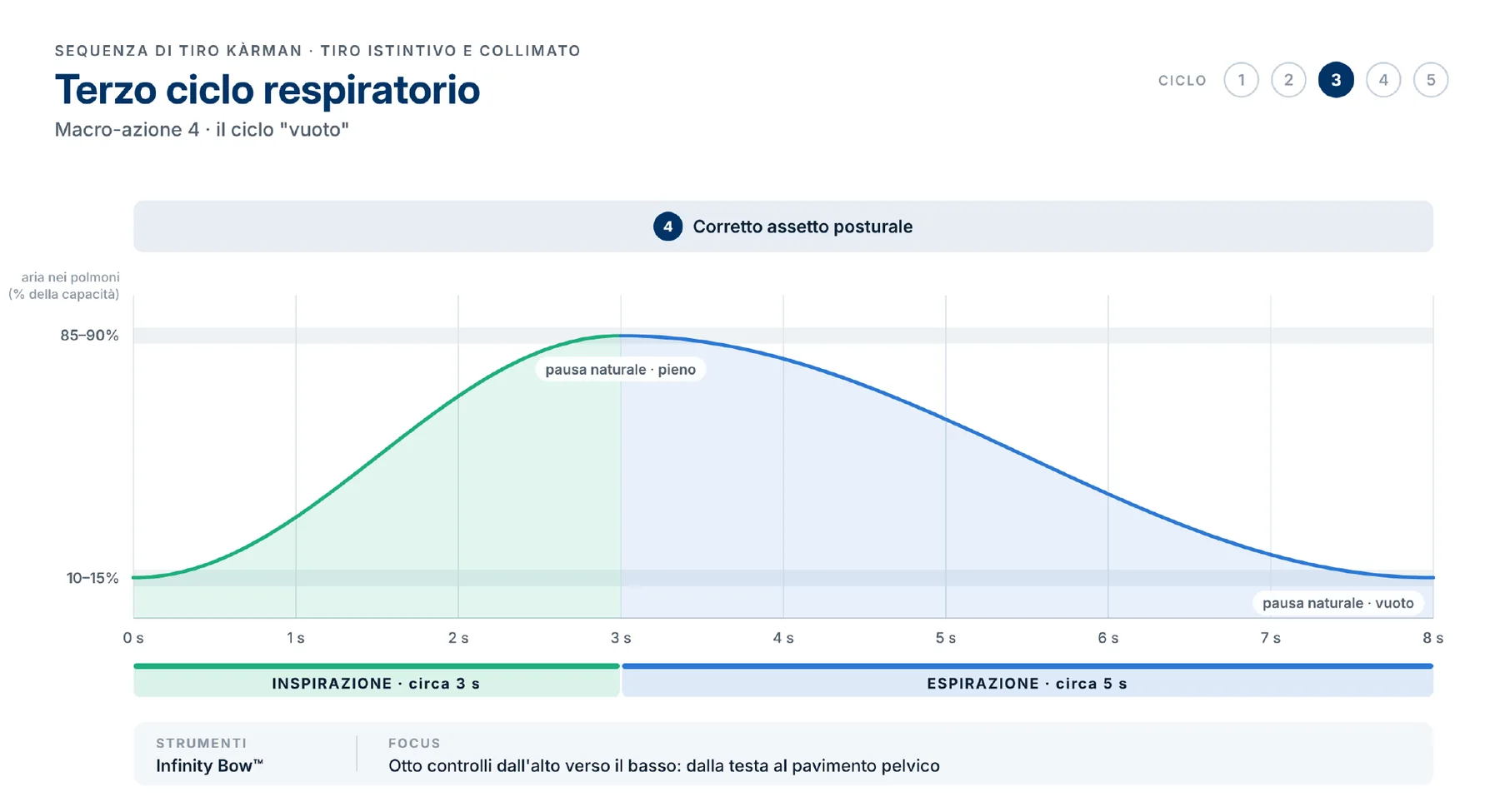
The third cycle is entirely devoted to posture. The book calls it an “empty” cycle, in which taking away is better than adding: a posture that is solid and at the same time relaxed and natural works better than an elaborate, artificial one. The Kàrman Method draws on the basic posture of the internal disciplines (Tai Ji Quan and Qi Gong) and combines it with modern archery, following the three principles of the Eastern tradition: regulating the body (tiao shen), the breath (tiao xi) and the heart-mind (tiao xin).
The sequence of checks, from top to bottom
- Head. Upright, with the chin slightly drawn back towards the nape: the cervical vertebrae lengthen and the crown (the highest part of the skull) points to the sky, as if held up by a thread. The neck is relaxed, neither forward nor back. From this position the head will turn towards the target, keeping the crown pointing to the sky.
- Relaxed face. Lips slightly parted in a light smile, teeth touching without clenching, tip of the tongue behind the upper incisors. The book notes that this is not essential in archery, but it has no drawbacks and helps release tension in the face.
- Shoulders. Low and relaxed, in line with the hips: the trunk does not move forward or back relative to the pelvis. The shoulders are actively depressed by the lower trapezius and the latissimus dorsi, with the serratus anterior stabilising the scapula on the rib cage. This creates space between the scapulae and between the collarbones, and the chest does not collapse on exhalation.
- Chest. Open and broad, with the sternum pushed slightly towards the spine. It receives the breath by expanding in all directions: forward, back, up and down. Breathing must never be forced.
- Abdomen and pelvis. Abdomen relaxed and open, navel drawn towards the spine, buttocks as if resting on a high stool. The pelvis tilts slightly backwards and the lumbosacral area lengthens. The rest of the muscles keep only their natural tone.
- Legs and feet. The weight descends along the central axis of the body and spreads evenly over the soles of the feet: at the base of the big toe and little toe, along the outer edge and on the heels. The toes touch the ground without pressing; the feet are parallel, shoulder-width apart, under the hips.
- Knees. A slight natural bend, that is, unlocked and slightly flexed; never rigidly hyperextended. They stay in line with the toes and do not go beyond them.
- Pelvic floor. It releases on inhalation, taking part in the expansion of the trunk, and lifts slightly on exhalation.
With the Infinity Bow™
During the third cycle the Infinity Bow™ is held in front of the torso, already hooked and in pro-grip, without drawing. Its low weight (310 g) is a real advantage here: a traditional bow weighs from 1.5 to 2.5 kg, and its mass tends to pull the trunk forward and accentuate the lumbar curve; with the Infinity Bow™ the centre of gravity stays almost unchanged and the archer can devote themselves entirely to listening to their posture.
In educational terms, the third cycle is a moment of “emptying”. At first the Instructor guides the scan with their voice; over time the learner learns to lead it alone, in silence. It is one of the first steps towards autonomy.
Exercises
Exercise 4.1 — Top-to-bottom scan. During the exhalation the Instructor names, one at a time, the eight points of the sequence; the archer brings attention to each and lets go of any tension found there. Over time the scan becomes silent and is completed in a single cycle.
Exercise 4.2 — Unlocking knees and pelvis. Standing, the archer unlocks the knees and makes small backward tilts of the pelvis, until finding the position in which the lower back lengthens without effort.
Exercise 4.3 — Trunk stability. The archer holds the set-up while the Instructor applies light side pushes on the Infinity Bow™: the trunk stays stable for a whole breathing cycle, without holding the breath.
Exercise 4.4 — The Golden Thread. A Qi Gong exercise reported in the book (by R. Burgo). Feet shoulder-width apart, eyes half-closed: the archer visualises the shoulder area as a block of ice melting into water and flowing down to the Tan Tien, three fingers below the navel. Then they imagine a golden thread pulling the head upwards from the crown: the chin draws in naturally and the seventh cervical vertebra (C7), the eleventh thoracic vertebra (T11) and the sacrum come into line. They open their eyes again before the raise.
Exercise 4.5 — Breathing and pelvic floor. For a few cycles the archer feels the pelvic floor release on inhalation and lift slightly on exhalation.
| Exercise | Accessory | Breathing and focus | Indicative volume | Rest between sets |
|---|---|---|---|---|
| Ex. 4.1 Top-to-bottom scan | Infinity Bow™ | Exhalation; eight points in order | 3 sets of 3 cycles | 45 seconds |
| Ex. 4.2 Unlocking knees and pelvis | — | Continuous diaphragmatic breathing | 3 sets of 1 minute | 30 seconds |
| Ex. 4.3 Trunk stability | Infinity Bow™ | A whole cycle; fluid breathing, no holding | 3 sets of 3 cycles | 60 seconds |
| Ex. 4.4 The Golden Thread | — | Eyes half-closed; attention on the crown | 3 repetitions | 45 seconds |
| Ex. 4.5 Breathing and pelvic floor | — | Release on IN, lift on OUT | 5 cycles | — |
Frequent errors and how to support their correction
- Chin raised: the “thread” is attached to the forehead rather than the crown; repeat Exercise 4.4.
- Shoulders rising on inhalation: breathing is still in the chest; go back to Exercise 1.3.
- Knees locked in hyperextension or, on the contrary, too bent: Exercise 4.2.
- Wanting to correct everything at once: one check at a time, in order. The regularity of the scan matters more than its perfection.
Bridge to the bow
With the school bow the scan stays the same. It is useful to alternate one set-up cycle with the Infinity Bow™ and one with the bow, to check that the greater weight does not alter the posture just built.
6.5Fourth Breathing Cycle — From the Raise to the Release (Macro-actions 5–12)
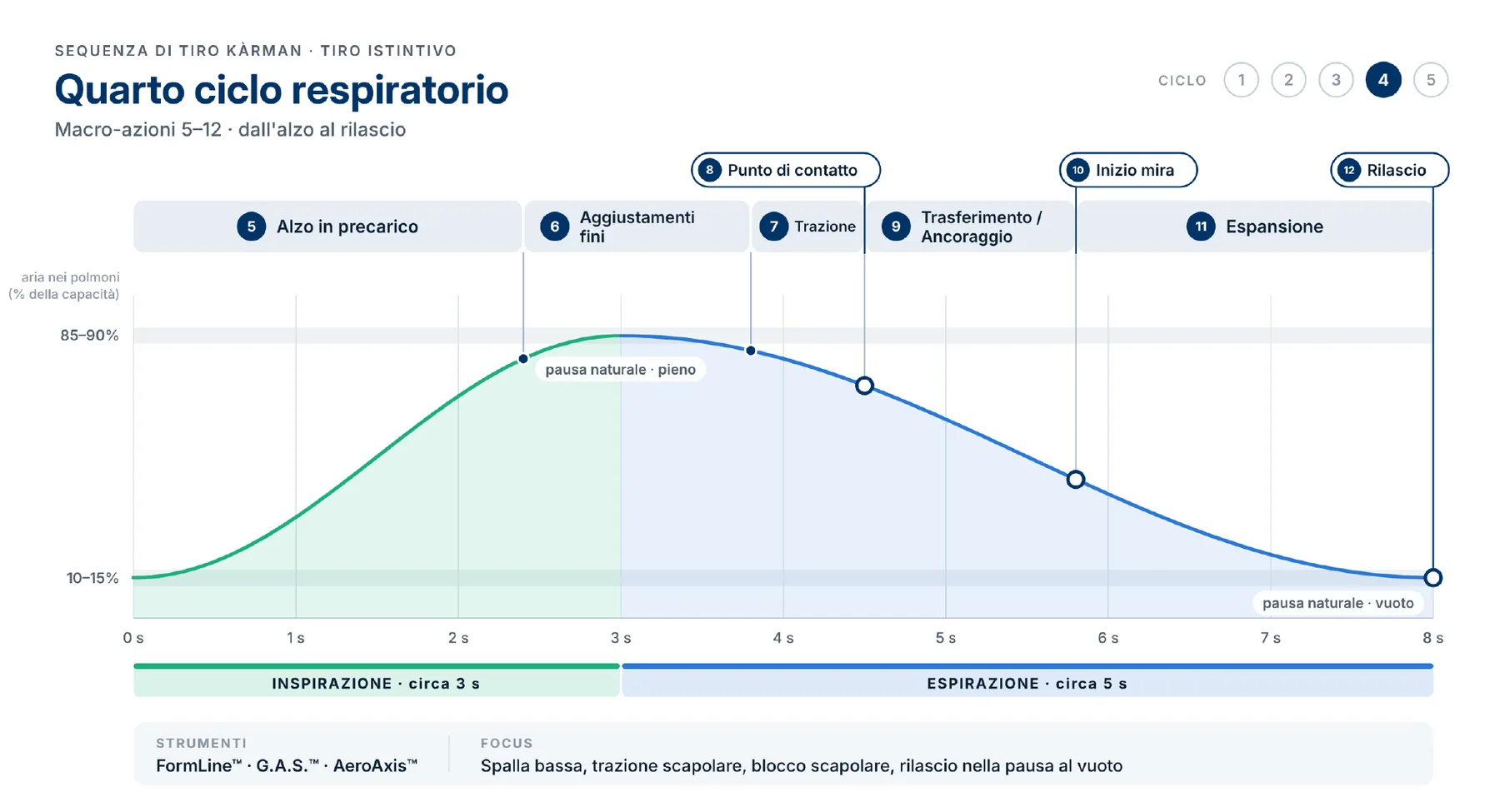
The fourth cycle is the dynamic heart of the sequence. In instinctive shooting it contains eight macro-actions, from raising the bow to the release. In sighted shooting it ends with the transfer/anchor (macro-action 9): aiming, expansion and release move to the fifth cycle (section 6.7). The timings in the table are taken from the charts in the book and are to be understood as indicative.
| Time (approx.) | Breath | Macro-action (instinctive shooting) |
|---|---|---|
| 0–2.4" | Inhalation | 5) Pre-loaded raise |
| 2.4–3.8" | End of inhalation and natural pause at full | 6) Fine adjustments |
| 3.8–4.5" | Start of exhalation | 7) Draw |
| 4.5" | Exhalation | 8) Contact point |
| 4.5–5.8" | Exhalation | 9) Transfer / Anchor point |
| 5.8" | Exhalation | 10) Start of aiming |
| 5.8–8" | Exhalation | 11) Expansion |
| 8" | Natural pause at empty | 12) Release |
5) Pre-loaded raise
The inhalation accompanies the raising of the bow. The bow arm extends, activating the triceps; the bow shoulder, at the joint between the humerus and the glenoid cavity, is internally rotated. As if drawing a half-moon, the bow rises until it is a hand-span above shoulder height, then gently comes down until the scapulohumeral complex is aligned. The string hand follows the raise without ever crossing the imaginary vertical line from the bow shoulder to the bow-side foot, parallel to the spine, and stops about a palm’s width from the facial contact point. The alignments built in the third cycle must not break: in particular, the shoulders stay low.
With the Infinity FormLine™. The elastic tube connecting the frame to the foot counters the lift and asks the bow shoulder to activate its stabilisers (latissimus dorsi, lower trapezius, rotator cuff) to stay low and open. It is the most suitable tool for learning to raise without “lifting the shoulder”. Resistance is adjusted with the sliding mechanism: start with a long circuit, that is, with little resistance, and shorten it gradually.
6) Fine adjustments
The inhalation is complete. In the brief natural pause between inhalation and exhalation the archer perceives their body and their alignment with the target, and carries out a few checks in quick succession:
- weight: with the bow raised it tends to shift onto the bow-side foot and must be rebalanced over the soles of the feet, without pulling the shoulders back on the opposite side (a frequent error that compromises the postural set-up);
- trunk: position of the pelvis, contraction of the abdominals and a very slight forward lean of the torso;
- the two contacts: the pro-grip and the string hook must not have moved.
The book gives the fine adjustments two goals: to correct any involuntary shifts and to give the archer greater confidence. It is the moment in which self-trust is cultivated.
With the G.A.S.™. In the pause at full the archer checks that the cross is still centred and the bubble in the middle: it is the objective check of the third item on the list.
7) Draw
With the start of the exhalation the draw begins, with a relaxed and decisive movement. The scapula of the string arm moves towards the spine through the contraction of the back muscles, in particular the trapezius. The archer’s attention is on the movement of the scapula; the string arm stays as passive as possible: the hand merely holds the string and the arm acts as a bridge between hand and shoulder.
With the AeroAxis™ (on the string-arm elbow). On the frontal plane the Aero-Line shows whether the string elbow rises, stays in line or drops relative to the shoulder line. It is the most useful feedback for learning to draw “with the back” and not with the biceps.
8) Contact point and 9) Transfer / Anchor point
In the Kàrman Sequence, contact point and anchor point are two different things. The key concept is that the draw does not end at the facial contact point. When the index finger of the string hand touches the contact point (usually the corner of the mouth in instinctive shooting, the base of the chin in Olympic recurve), the transfer of the load begins.
During the transfer, about 80% of the force held by the drawing scapula is distributed across all the joints, from the bow arm to the scapulohumeral lock of the string arm. This is the “scapular lock”, the true anchor point. The book describes three effects:
- biomechanical: the index finger slides a few millimetres towards the string shoulder and the string elbow moves back and down;
- sensory: a markedly greater feeling of stability;
- mental: the prevention of unwanted conditioning, such as involuntary releases and difficulty aiming at the target.
The geometry formed between the push of the bow arm and the pull of the scapula is the “push/pull” position described in the book; in the international technical literature it is often called the Wedge position.
With the AeroAxis™. On the transverse plane the Aero-Line aligns with the shoulder line only when the scapular rotation is correct, and the cord lightly brushes the knuckles of the string hand and the base of the neck. If the shoulders are “closed”, the cord stays detached. The contact of the cord is tactile information that the archer learns to recognise even with eyes closed.
10) Start of aiming and 11) Expansion
The book describes aiming with the Aristotelian pair of act and potential: “A seed is a seed in act and a tree in potential.” To aim is to build a bridge of intent between oneself and the target: the archer focuses on a precise point but, above all, visualises the bridge that links them to that point, not just the trajectory of the arrow.
Expansion is the passage from the act of aiming to its potential: an expansion of physical and mental control. Biomechanically, the bow hand tends to push as if moving towards the target, while an almost imperceptible movement of the rhomboids moves the string elbow back very slightly and lengthens the natural draw by 1, at most 2 mm. Expansion unfolds during the exhalation and leads to the release.
With the Infinity Bow™. Aiming does not require a target. A progression is proposed: first a neutral point on the wall, at eye level; then a target face; only later the real target, with the bow. In this way aiming is built as a “bridge” and not as anxiety to hit.
The accessory for expansion depends on the shooting style:
- Instinctive shooting and barebow: expansion is trained through proprioception alone, without aids.
- Olympic recurve: the Clicker Simulator™, attached to the Infinity Bow™, clicks at the end of the expansion. Resistance depends on the plunger: start with the Light plunger and move gradually to Medium and Hard.
- Compound: the I-Loop, clipped to the cord, provides an end stop that simulates the wall. The archer learns to expand against the wall without pushing the bow arm forward and without giving way with the string arm.
12) Release
The release closes the fourth cycle, in the natural pause that follows the exhalation. The book describes it as letting go of the expression of an intention, to be sought as “an explosion of relaxation”, in the awareness that everything that had to be done has been done. This is why it is one of the hardest phases to learn: it cannot be solved with a mechanical gesture. At first the Kàrman System teaches a release with a relaxed hand; later the release is shaped to the archer and their goal (in some situations, such as dynamic shooting, more explosive releases are more effective).
With the Infinity Bow™. The cord slips off the fingers and the elastic returns guided by the inner side projections, which prevent it from striking the forearm. After the release the string makes a slight rotation: it is brought back into position with light manual pressure before the next repetition.
Fourth-cycle exercises
Exercise 5.1 — Half-moon raise. On a full inhalation, the archer raises the Infinity Bow™ a hand-span above the shoulders and brings it back into line, with the string hand stopping a palm’s width from the face. The Instructor watches the shoulders.
Exercise 5.2 — Raise with the Infinity FormLine™. The same movement with the tube hooked to the foot: the bow shoulder stays low against the resistance. The circuit is shortened only when the movement is stable.
Exercise 6.1 — Pause at full with the G.A.S.™. At the end of the inhalation the archer checks weight, trunk, cross and bubble, and starts exhaling again only after the check.
Exercise 7.1 — Scapular draw with the AeroAxis™. On the exhalation, a slow draw while watching the Aero-Line on the frontal plane: the string elbow comes into line with the shoulders.
Exercise 9.1 — Contact and transfer. Draw to the contact point, then transfer: the archer feels the index finger slide and the elbow lower, and holds the anchor until the end of the exhalation. The contact point is always the same.
Exercise 9.2 — Anchoring with eyes closed. The same exercise with eyes closed: the archer recognises the scapular lock from the feel of the AeroAxis™ cord on the knuckles and at the base of the neck.
Exercise 11.1 — Bridge of intent. With the neutral point on the wall, the archer performs the whole fourth cycle, concentrating on visualising the bridge and on the 1–2 mm expansion.
Exercise 11.2 — Expansion with the Clicker Simulator™ (Olympic recurve). The expansion leads to the click, which must come during the exhalation, without holding the breath. If the click does not come by the end of the exhalation, the archer lowers the tool and starts again: knowing how to interrupt a shot is also a choice to be trained.
Exercise 11.3 — Expansion against the wall with the I-Loop (compound). The archer reaches the end stop and keeps contact with the wall.
Exercise 12.1 — Release as relaxation. At the end of the exhalation, in the natural pause, the archer lets the cord slip away by extending the fingers, without actively opening them. The criterion is not speed, but the absence of noise and of sideways hand movement.
| Exercise | Accessory | Breathing and focus | Indicative volume | Rest between sets |
|---|---|---|---|---|
| Ex. 5.1 Half-moon raise | Infinity Bow™ | Full inhalation; shoulders low | 3 sets of 5 cycles | 45 seconds |
| Ex. 5.2 Raise with FormLine™ | Infinity FormLine™ | Inhalation; bow shoulder low against the resistance | 3 sets of 5 cycles | 60 seconds |
| Ex. 6.1 Pause at full | G.A.S.™ | Natural pause; cross and bubble centred | 3 sets of 5 cycles | 45 seconds |
| Ex. 7.1 Scapular draw | AeroAxis™ | Start of exhalation; elbow in line with the shoulders | 3 sets of 5 cycles | 60 seconds |
| Ex. 9.1 Contact and transfer | AeroAxis™ | Exhalation; consistent contact, then scapular lock | 4 sets of 5 cycles | 60 seconds |
| Ex. 9.2 Anchoring with eyes closed | AeroAxis™ | Recognise the lock from the feel of the cord | 3 sets of 5 cycles | 60 seconds |
| Ex. 11.1 Bridge of intent | Neutral point on the wall | Full cycle; expansion of 1–2 mm | 3 sets of 5 cycles | 60 seconds |
| Ex. 11.2 Expansion with clicker | Clicker Simulator™ | Click on exhalation; Light plunger at first | 3 sets of 5 cycles | 90 seconds |
| Ex. 11.3 Expansion against the wall | I-Loop | Continuous contact with the end stop | 3 sets of 5 cycles | 90 seconds |
| Ex. 12.1 Release as relaxation | Infinity Bow™ | Pause at empty; fingers extending | 3 sets of 5 cycles | 60 seconds |
Frequent errors and how to support their correction
- Bow shoulder rising during the raise: Exercise 5.2 with the Infinity FormLine™.
- String elbow too high or too low, drawing with the biceps: Exercise 7.1 with the AeroAxis™.
- Draw stopping at the contact point, without transfer: Exercise 9.1.
- Breath held while aiming or expanding: go back to Exercise 1.3 and shorten the aiming time.
- “Open” or noisy release, with the fingers actively opening: Exercise 12.1.
- Elastic striking the forearm: bow elbow not correctly rotated or shoulder high; review Exercises 5.1 and 5.2.
Bridge to the bow
The fourth cycle is transferred to the bow in stages. First only the sequence of raise, adjustments, draw and anchor, letting the bow down without releasing; then the complete sequence at close range, on a boss without a target face; only later on a target face. Alternating “one sequence with the Infinity Bow™, one arrow with the bow” helps to recognise and keep the same sensations.